


Document Source: Order of Battle of the United States Army, World War II, European Theater of Operations. Office of the Theater Historian, Paris, France, December 20, 1945.

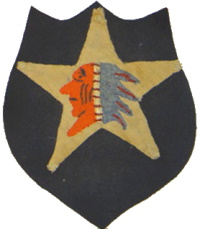 The 2nd Division was first constituted on September 21, 1917, in the Regular Army. It was organized on October 26, 1917, at Bourmont, Department of the Haute-Marne, France. When the unit’s activation order was transmitted to the HQs of the AEF (American Expeditionary Force) the assignments responded to the following battle order: Headquarters, 2nd Division, 3rd Infantry Brigade, 9th Infantry Regiment, 23rd Infantry Regiment, 5th Machine Gun Battalion, 4th Marine Brigade, 5th Marine Regiment, 6th Marine Regiment, 6th Machine Gun Battalion, 2nd Field Artillery Brigade, 12th Field Artillery Regiment (75-MM), 15th Field Artillery Regiment (75-MM), 17th Field Artillery Regiment (155-MM), 2nd Trench Mortar Battery, 4th Machine Gun Battalion, 2nd Engineer Regiment, 1st Field Signal Battalion, Headquarters Troop, 2nd Division, 2nd Train Headquarters, and Military Police, 2nd Ammunition Train, 2nd Supply Train, 2nd Engineer Train, 2nd Sanitary Train, 1st Ambulance Company, 15th Ambulance Company, 16th Ambulance Company, 23rd Ambulance Company and, finally, the Field Hospitals. During World War One, the division was twice commanded by US Marine generals, Gen Charles A. Doyen, and Gen John A. Lejeune, the only time in US history when USMC officers commanded a Regular Army division.
The 2nd Division spent the winter of 1917–1918 training with both, French and Scottish trenches veterans. Though judged unprepared by French tacticians, the AEF was committed to combat in the spring of 1918 in a desperate attempt to halt a German advance toward Paris. Gen Edward Mann Lewis was in charge of the 3rd Brigade as they deployed to reinforce the battered French troops along the Paris-Metz road. The Division first fought the Battle of the Belleau Wood and contributed to shattering the four-year-old stalemate on the battlefield during the Château-Thierry campaign that followed.
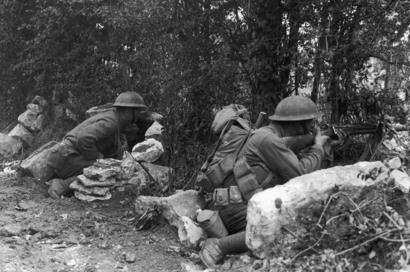 On July 28, 1918, Marine Corps Gen Lejeune assumed command of the 2nd Division and remained in that capacity until August 1919, when the unit returned to the United States. The division went on to win hard-fought victories at Soissons and Blanc Mont. Finally, the Indianhead Division participated in the Meuse-Argonne Offensive which ended any German hope for victory.
On November 11, 1918, at 1111, the Armistice was declared, and the 2nd Division entered Germany, where it assumed occupation duties until April 1919 and was sent back home, in July 1919.
The 2nd Division was three times awarded the French Croix de Guerre for gallantry under fire in the Belleau Wood, Soissons, and Blanc Mont. This entitles current members of the division and of those regiments that were part of the division at that time, 5th Marine Regiment and 6th Marine Regiment included, to wear a fourragère in commemoration.  The Navy authorized a special uniform change that allows hospital corpsmen assigned to the 5th and 6th Marine Regiments to wear a shoulder strap on the left shoulder of their dress uniform so that the fourragère can be worn.
2nd Division, AEF, WW-1 Casualties were as follows: 1964 (Infantry) and 4478 (USMC) KIA. 9782 (Infantry) and 17.752 (USMC) WIA. Major Operations: the Third Battle of the Aisne, Belleau Wood, Château-Thierry, St Mihiel, Meuse-Argonne, Aisne-Marne. Back Home, the division was stationed at Fort Sam Houston (Texas) and was one of the three divisions to remain intact and on active duty for the entire interwar period. The Indian Head Division remained there for the next 23 years, serving as an experimental unit, testing new concepts and innovations for the Army. The 2nd Division stationed part at Camp Bullis (Texas) and part at Fort Sam Houston (Texas) was the first command reorganized under the new triangular concept of organization theory of warfare, which provided for three separate regiments in each division.
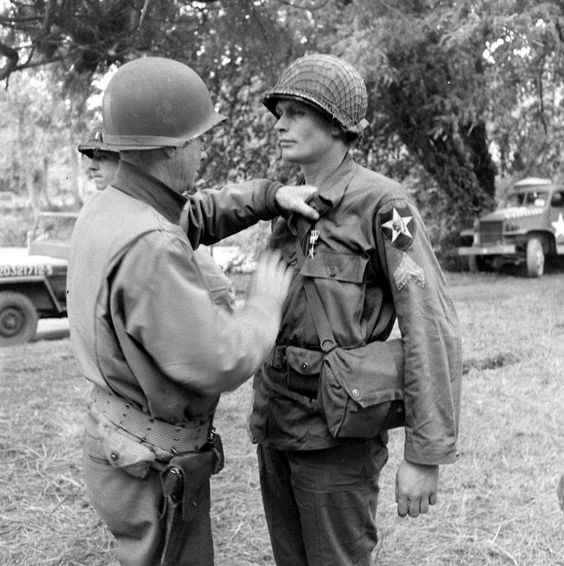
 The Division participated in maneuvers at Christine (Texas), between January 3 to 27, 1940. It then moved to Horton (Texas), for maneuvers from April 26 to May 28, followed by maneuvers at Cravens (Louisiana) from August 16 to August 23. It returned to Fort Sam Houston where it continued training and refitting until it moved to Brownwood (Texas), for the VIII Corps June 1 to 14, 1941, maneuvers at Comanche (Texas). The division was then sent to Mansfield (Louisiana) from August 11 through October 2 for the August-September 1941 Louisiana Maneuvers. Transferred to the VIII Corps Louisiana maneuver Area on July 27, and being redesignated as the 2nd Infantry Division in August, the Indian Head soldiers remained there until September 22, 1942, whereupon the formation returned to Fort Sam Houston and moved to Camp McCoy (Wisconsin), on November 27, 1942. Four months of intensive training for winter warfare followed. In September 1943, the 2-ID received their staging orders and moved to the Camp Shanks (New York), staging area at Orangeburg (New York) on October 3, where they received Port Call orders and on October 8, the division officially sailed from the New York Port of Embarcation (POE) and started arriving in Belfast (Northern Ireland) on October 17. They then moved over to England, where they trained and staged for the forwarding movement to France.
2-ID – Casualties
Killed in Action: 2999
Wounded in Action: 10.924
Missing in Action: 109
Captured: 1034
Battle Casualties 15.066
Non-Battle Casualties 10.818
Total Casualties: 25.884.
2-ID – Campaigns
Normandy
Northern France
Ardennes France
Rhineland
Belgium and Germany
Central Europe
2-ID – Awards
Medal of Honor 6
Distinguished Service Cross 34
Legion of Merit 25
Silver Star 637
Soldiers Medal 14
Bronze Star 5484
Air Medal 82
POWs taken 51.055
Division Commander
Maj Gen John C. H. Lee – November 1941 – October 1943.
Maj Gen Walter M. Robertson – October 1943 – November 1943.
Brig Gen Thomas L. Martin – November 1943 – December 1943.
Maj Gen Walter M. Robertson – December 1943 – June 1945.
Brig Gen William K. Harrison – June 1945 – September 1945.
Maj Gen Edward M. Almond – September 1945.
Assistant Division Commander
Brig Gen Thomas L. Martin – October 1943 – July 1944.
Col James A. Van Fleet – July 1944 – August 1944.
Brig Gen James A. Van Fleet – August 1944 – September 1944.
Col John H. Stokes Jr – September 1944 – March 1945.
Brig Gen John H. Stokes Jr – March 1945.
Artillery Commander
Gen George P. Hays – October 1943 – November 1944.
Col Richard Sears – November 1944 – November 1944.
Gen John H. Hinds – November 1944.
Chief of Staff
Col John H. Stokes Jr – October 1943 – October 1944.
Col Ralph W. Zwicker – October 1944 – VEDay.
Assistant Chief of Staff G-1
Lt Col Reuben N. Hansen – October 1943 – April 1944.
Maj Arthur M. Sherwood III – April 1944 – July 1944.
Lt Col Arthur M. Sherwood III – July 1944 – VEDay.
Assistant Chief of Staff G-2
Lt Col Donald P. Christensen – October 1943 – VEDay.
Assistant Chief of Staff G-3
Lt Col Jay B. Loveless – October 1943 – December 1943.
Lt Col John H. Chiles – December 1943 – December 1944.
Maj Daniel Webster – December 1944 – January 1945.
Lt Col Daniel Webster – January 1945 – VEDay.
Assistant Chief of Staff G-4
Lt Col Homer S. Reese – October 1943 – VEDay.